Mental game training and performance psychology visual | Therapycise, the authority on the mental game

Your Clients’ Bodies Are Ready. Are Their Minds?

If you work with athletes professionally, you already know this truth:

Physical preparation is only half the job.

You can optimise strength.
You can refine mechanics.
You can perfect nutrition.
You can reduce injury risk.

But if your client cannot manage pressure, regulate emotion, stay consistent or recover mentally from setbacks — performance will stall.

And you feel it too.

This is where Therapycise steps in.


For Strength & Conditioning Coaches

You build physical capacity. You develop robustness. You increase power output.

But when an athlete skips sessions due to confidence dips, overthinks competition, or emotionally spirals after a bad performance — it’s not a programming issue.

It’s mental architecture.

Referring to Therapycise strengthens compliance, consistency and execution. Athletes show up sharper, more accountable and clearer in purpose.

Stronger mind. Better training outcomes.


For Physiotherapists, Chiropractors & Sports Masseuses

You manage recovery. You guide rehabilitation. You rebuild trust in the body.

But fear of re-injury, frustration during rehab, and identity loss during downtime can derail physical progress.

Mental performance support accelerates rehabilitation by:

  • Improving emotional regulation
  • Strengthening patience and discipline
  • Reducing anxiety around return-to-play
  • Rebuilding confidence in movement

When the mind trusts the body again, recovery becomes smoother.


For Nutritionists & Performance Dietitians

You optimise fuel. You educate. You personalise.

But adherence, discipline and emotional relationships with food are psychological.

When mindset aligns with goals, behaviour stabilises. Clients follow through. Standards hold.

Mental clarity strengthens nutritional consistency.


For Sports Analysts, Biomechanics Coaches & Running Coaches

You refine detail. You improve marginal gains. You focus on technical precision.

But under pressure, technique collapses if emotional control is unstable.

Performance data means nothing if the athlete cannot regulate attention or reset after error.

Mental game training protects the gains you work hard to create.


For Sports Agents, Team Managers & Team Coaches

You manage careers. You oversee dynamics. You lead systems.

You see talent lost to poor decision-making.
You see potential disrupted by emotional volatility.
You see inconsistency where there should be dominance.

Mental performance work builds:

  • Composure under scrutiny
  • Identity stability
  • Leadership presence
  • Performance reliability

That strengthens squads and careers long-term.


Why Refer to Therapycise?

Because you care about your clients’ full performance picture.

At Therapycise, we don’t compete with your work. We complement it.

We develop:

  • Confidence
  • Clarity
  • Composure
  • Consistency
  • Control

We build all-round mental resilience while focusing sharply on the client’s primary objective. Whether that’s return-to-play confidence, competition composure, leadership stability or performance consistency — we go all in.

Our work strengthens the outcomes you’re already driving physically and technically.

When your client improves mentally, your impact multiplies.


Why Professionals Trust Us

We speak performance language.

We understand sporting, corporate and scholar environments.

We don’t offer generic motivation. We build structured mental systems that align with physical preparation cycles and performance schedules.

Nearly 150 five-star reviews reflect one core theme: clarity and growth.

And when professionals refer to Therapycise, they know their clients will be looked after properly.


The Shared Mission

Every serious performance professional wants the same thing:

Stronger. Smarter. More resilient athletes.

Mental performance training is not an add-on. It is the layer that protects everything else.

If you want your clients operating at their best with their minds — while you optimise the rest — Therapycise is built for that collaboration.

If you’d like to understand the foundational framework behind our work, start here:

👉 The First Post You Should Read If You Want to Be the Best Athlete You Can Possibly Be MENTALLY
https://therapycise.co.uk/posts-must-read-for-athletes/

Because when body and mind are aligned, performance stops leaking.

It accelerates.
Mental game training and performance psychology visual | Therapycise, the authority on the mental game

Our All-Round Approach to the Mental Game (And Why It Works)

There are two types of mental performance support.

The kind that talks about confidence.

And the kind that builds it properly.

At Therapycise, we take an all-round approach to the mental game because performance is never one-dimensional. You don’t compete, lead, or study with just one psychological skill. You show up with your identity, your habits, your preparation, your emotional control, your routines, your standards and your resilience — all at once.

So we train all of it.

And that’s why it works.


We Build All-Round Warriors

Sporting athletes.
Corporate athletes.
Scholar athletes.

Different arenas. Same principle.

We don’t just focus on a single performance issue. We develop:

  • Confidence that is built through preparation
  • Clarity in identity and goals
  • Composure under pressure
  • Consistency in routines
  • Control over emotional responses

We strengthen the entire mental system so that when pressure hits, there is something solid to fall back on.

That’s what creates all-round performers.

Not fragile confidence. Not temporary motivation.

Resilient capability.


But We Also Go All In on the Major Objective

Here’s the difference.

While we develop the full mental architecture, we also identify the primary objective and attack it with precision.

If your biggest gap is emotional control, we go all in on emotional regulation.

If it’s preparation structure, we build that system relentlessly.

If it’s identity confusion, we clarify standards and expectations properly.

We don’t drift.

We lock onto the major area of focus like it matters — because it does.

This combination is powerful:

Wide foundation.
Sharp focus.

That balance creates momentum quickly while protecting long-term development.


Why Our All-Round Mental Game Approach Works

It works because it mirrors reality.

Performance environments are complex. Pressure is unpredictable. Emotion is dynamic.

A narrow mental game strategy collapses under stress.

An all-round mental performance system adapts.

Our clients develop:

  • Structured preparation cycles
  • Clear weekly routines
  • Defined standards
  • Reset strategies
  • Reflection habits
  • Recovery awareness

This reduces decision fatigue, increases confidence stability and sharpens execution.

In neuroscience terms, repetition builds neural efficiency. In performance terms, structure builds certainty.

Certainty builds confidence.

Confidence builds performance.


We Love Clarity. We Love Going All In.

Ambiguity kills performance.

That’s why we ask hard questions.

What do you stand for?
What is your primary goal?
Where is the biggest gap in your mental game knowledge?
What obstacles are likely to derail you?

Clarity creates direction.

Direction creates action.

And action creates growth.

We don’t skim the surface. We don’t avoid uncomfortable truths. We align identity, preparation and behaviour so everything moves in the same direction.

When clients experience that level of clarity, they don’t just improve.

They transform.


Why We Get So Many Word-of-Mouth Referrals

Simple.

We look after our clients.

We don’t disappear after one session.
We don’t deliver generic advice.
We don’t protect ego at the expense of growth.

We build people up.

Our sporting athletes perform more consistently.
Our corporate athletes lead with more control and composure.
Our scholar athletes develop structure and resilience that lasts beyond exams.

When people feel stronger, clearer and more capable — they talk about it.

Word of mouth isn’t marketing.

It’s proof.

Nearly 150 five-star reviews reflect something deeper than satisfaction. They reflect trust. Progress. Growth.

And when someone feels like they’ve become an all-round warrior — they don’t keep that quiet.


The Therapycise Difference

We combine:

Broad mental game development
+
Relentless focus on the major objective

That’s why clients don’t just feel supported.

They feel sharpened.

This is mental performance training done properly. Structured. Personalised. Evidence-based. Applied.

If you want to understand the full framework that underpins our all-round approach, start here:

👉 The First Post You Should Read If You Want to Be the Best Athlete You Can Possibly Be MENTALLY
https://therapycise.co.uk/posts-must-read-for-athletes/

Read it carefully.

Then decide if you’re ready to go all in on your mental game.

Because when you train the whole system — and attack the key objective with precision — performance stops being accidental.

It becomes inevitable.

Mental game training and performance psychology visual | Therapycise, the authority on the mental game

The Missing Piece for Winners? Your Mental Game.

Winners in sport train their bodies relentlessly.
Winners in business sharpen their strategy.
Winners in education refine their knowledge.

But across sporting, corporate, and scholar environments, one truth keeps showing up:

The mental game decides who sustains success.

Talent gets attention.
Effort earns opportunity.
But mindset determines outcomes.

If you’ve ever felt like you’re close — but not quite consistent — there’s a strong chance the missing piece isn’t skill.

It’s structure in your mental game.


Sporting Athletes: When Skill Isn’t the Problem

You’ve done the physical preparation.
You’ve put in the hours.

But under pressure:

  • Confidence dips
  • Focus fractures
  • Emotion overrides execution
  • One mistake becomes two

This is not a technical issue.

It’s mental performance.

Elite sporting athletes don’t leave composure to chance. They train confidence through preparation systems. They rehearse pressure. They build routines that stabilise emotion and sharpen attention.

When the mental game is trained, performance becomes repeatable.


Corporate Athletes: Pressure Without a Whistle

There’s no final whistle in business.

Just sustained expectation.

Deadlines. Decisions. Responsibility. Leadership. Visibility.

Corporate athletes operate in high-cognitive-load environments where clarity, emotional control, and strategic thinking are everything.

Without structured mental performance work, you see:

  • Decision fatigue
  • Reactive communication
  • Confidence inconsistencies
  • Burnout cycles

The mental game is not “soft skills.”

It’s performance stability.

Train focus.
Train emotional regulation.
Train recovery.

And output improves.


Scholar Athletes: The Hidden Performance Arena

Students are under more pressure than ever.

Expectation. Comparison. Academic demand. Future uncertainty.

Scholar athletes who lack mental game systems often:

  • Overthink exams
  • Struggle with procrastination
  • Lose momentum after setbacks
  • Tie identity too tightly to results

Mental performance training builds:

  • Structured study routines
  • Performance confidence
  • Emotional resilience
  • Clear preparation cycles

Knowledge matters.
But mindset unlocks it.


Why Winners Invest in Mental Game Work

Here’s the uncomfortable truth:

Most people work on their mindset only when something breaks.

Winners work on it before it does.

Mental game training develops the five core drivers of sustainable performance:

  • Confidence
  • Clarity
  • Composure
  • Consistency
  • Control

These are not personality traits.

They are trainable capacities.

And once developed, they compound.


The Gap No One Talks About

You can be physically prepared.
You can be technically strong.
You can be intelligent and capable.

But if you lack:

  • A structured preparation system
  • A pressure response plan
  • A reflection process
  • A stable performance identity

You will always experience inconsistency.

The missing piece for winners is rarely effort.

It’s alignment between ambition and mental architecture.


Let Us Help You Build It

At Therapycise – The Authority on the Mental Game – we work with sporting athletes, corporate athletes, and scholar athletes who refuse to leave their performance to chance.

We don’t offer motivation.

We build systems.

We don’t chase confidence.

We train it.

We don’t react to setbacks.

We design around them.

If you are serious about upgrading your mental game and closing the gap between where you are and where you want to be, the next step is simple.

Start with the foundation.

👉 The First Post You Should Read If You Want to Be the Best Athlete You Can Possibly Be MENTALLY
https://therapycise.co.uk/posts-must-read-for-athletes/

Read it.
Reflect.
Then decide if you’re ready to operate like a winner.

Because the mental game isn’t an accessory to performance.

It is the engine.

Mental game training and performance psychology visual | Therapycise, the authority on the mental game

The Ideal Therapycise Client (Read This Carefully)

This is not for everyone.

The ideal Therapycise client doesn’t want hype.
They don’t want comfort.
They don’t want someone to tell them they’re doing great when they’re coasting.

They want growth.

They understand that the mental game decides outcomes — in sport, in business, in study, in life.

If that’s you, keep reading.


You’re a Sporting Athlete, Corporate Athlete or Scholar Athlete

Our ideal client sees themselves as an athlete — even if they never step on a pitch.

  • Sporting athletes competing under real pressure
  • Corporate athletes operating in demanding, high-stakes environments
  • Scholar athletes balancing performance, expectation and growth

You understand that performance environments reward clarity, resilience and composure.

You don’t see mindset as optional.
You see it as leverage.


You Know There Are Gaps in Your Mental Game Knowledge

This is key.

The ideal Therapycise client is self-aware enough to say:

“I don’t know what I don’t know.”

You might:

  • Struggle with consistency
  • Lose confidence under pressure
  • Overthink in competition
  • React emotionally to setbacks
  • Lack structure in preparation
  • Avoid reflection when performance dips

You don’t deny these gaps.
You want to close them.

Because you understand something powerful:

Awareness is not weakness.
Avoidance is.


You Value the 5 C’s

At Therapycise, we build performance around the 5 C’s:

  • Confidence
  • Clarity
  • Composure
  • Consistency
  • Control

The ideal client doesn’t chase motivation.

They train these qualities deliberately.

They understand confidence is built through preparation.
Clarity comes from structure.
Composure is trained through repetition.
Consistency is built through systems.
Control comes from identity.

If those words resonate, you’re already aligned.


You Believe in No Zero Days

The ideal Therapycise client does not wait for perfect conditions.

They don’t wait to “feel ready.”

They commit to no zero days.

Every day includes something that moves the mental game forward:

  • Reflection
  • Preparation
  • A mental reset
  • A tool from the Toolkit
  • A deliberate habit

Small daily actions compound.

You understand this.

You don’t need motivation — you need structure.


You Take Action

This is non-negotiable.

The ideal client reads something and applies it.

They:

  • Use the website intentionally
  • Join the Collective
  • Implement routines
  • Track progress
  • Ask better questions

They don’t collect knowledge.
They convert it into behaviour.

That’s why they grow faster.


You’re Open to Learning (Even When It Challenges You)

Growth is uncomfortable.

The ideal Therapycise client doesn’t resist feedback.
They lean into it.

They understand that performance psychology is not always flattering.

Sometimes it exposes:

  • Weak routines
  • Emotional volatility
  • Inconsistent identity
  • Gaps in preparation

But instead of defending ego, they build skill.

They don’t want to be protected.
They want to be better.


You See the Mental Game as a Competitive Edge

Sporting athletes use physical training to separate themselves.

Corporate athletes use strategic thinking.

Scholar athletes use structured study.

The ideal Therapycise client understands that the mental game is the multiplier across all three.

They want:

  • Confidence that doesn’t collapse
  • Focus that holds under distraction
  • Emotional control in difficult moments
  • Systems that stabilise performance
  • A performance identity that aligns with ambition

They want a foundation, not a fix.


You’re Ready to Train Properly

If you’re looking for surface-level advice, this isn’t your place.

If you’re ready to:

  • Build mental performance systems
  • Identify your Point A
  • Strengthen the 5 C’s
  • Eliminate zero days
  • Take ownership of your development

Then Therapycise is built for you.

We don’t build followers.

We build operators.

And if you’re serious about understanding the framework that underpins everything we do, start here:

👉 The First Post You Should Read If You Want to Be the Best Athlete You Can Possibly Be MENTALLY
https://therapycise.co.uk/posts-must-read-for-athletes/

Read it.
Apply it.
Then decide if you’re ready to level up.

Mental game training and performance psychology visual | Therapycise, the authority on the mental game

Find Your Point A Before You Chase Point B

Everyone talks about goals.

Very few people truly understand their starting position.

Before we build confidence.
Before we sharpen focus.
Before we talk about pressure, composure or performance psychology…

We identify Point A.

Point A is your current reality. Your mental baseline. Your performance truth.

And if you don’t understand Point A, your goals are guesses.


Why Point A Is the Most Important Part of Mental Performance

When new clients onboard with Therapycise, we don’t jump into tactics.

We start with clarity.

We ask:

  • What do you stand for?
  • What are your primary goals?
  • What are your secondary goals?
  • What has worked for you before?
  • What hasn’t?
  • What obstacles are likely to block your progress?
  • What do you look for in a performance psychologist or mental performance coach?
  • Where is the biggest gap in your mental game knowledge?
  • What is the number one outcome you want from your first session?

This isn’t admin.

This is architecture.

Because performance psychology is not about generic motivation. It’s about alignment. Identity. Strategy.

And alignment starts with knowing exactly where you are.


Your Mental Game Has a Baseline

Every athlete — sporting, corporate, or scholar — operates from a mental baseline.

You have:

  • Default emotional reactions
  • Default preparation habits
  • Default recovery patterns
  • Default thought processes under pressure

That baseline is your Point A.

Some athletes are disciplined but lack confidence.
Some are confident but inconsistent.
Some prepare well but crumble under expectation.
Some are driven but unclear on identity.

Without defining Point A, improvement becomes random.

With clarity, progress becomes measurable.


The Psychology Behind It

There’s a reason we anchor everything to a starting position.

In behavioural science, awareness precedes change. You cannot upgrade what you cannot see.

In neuroscience, the brain thrives on clarity. When objectives are specific and grounded in reality, cognitive load reduces and decision-making improves.

In performance coaching, misdiagnosis wastes time.

Understanding Point A allows us to:

  • Identify performance gaps
  • Strengthen existing strengths
  • Anticipate psychological obstacles
  • Personalise mental conditioning strategies
  • Create structured development plans

This is why high performers move faster. They stop pretending and start assessing.


What You Stand For Matters More Than What You Want

Goals without identity are fragile.

When we ask clients what they stand for, we are uncovering performance values.

Do you stand for discipline?
Composure?
Accountability?
Courage?
Consistency?

Because when pressure hits — and it always does — values anchor behaviour.

If your Point A includes unclear values, your preparation will wobble.

If your Point A includes strong values but weak routines, we build structure.

Point A tells us what to reinforce and what to rebuild.


Obstacles Aren’t Problems. They’re Predictors.

One of the most powerful onboarding questions we ask is:

“What obstacles might stop you progressing?”

This isn’t negativity. It’s strategic foresight.

Common obstacles include:

  • Time management issues
  • Emotional volatility
  • Overthinking
  • Perfectionism
  • Fear of judgement
  • Lack of accountability

When we identify obstacles early, we design around them.

Elite mental performance is proactive, not reactive.


The Biggest Gap in Your Mental Game Knowledge

This question often unlocks the breakthrough.

Many athletes don’t lack effort. They lack understanding.

They don’t know:

  • How to regulate emotions effectively
  • How to reset during competition
  • How to review performance properly
  • How to build repeatable confidence
  • How to structure mental preparation

When you identify the biggest gap in your knowledge, you accelerate growth.

Because vague improvement is slow. Targeted development is powerful.


The First Session Outcome: Precision Matters

“What is the number one outcome you want from the first session?”

This forces clarity.

Not “I want to be better.”

Not “I want more confidence.”

Specific outcomes drive specific conversations.

When athletes define the outcome they want immediately, engagement rises. Ownership increases. Momentum builds.

Understanding Point A ensures that the first step is not random — it is deliberate.


Why Most People Skip This Step

Because self-assessment is uncomfortable.

It exposes inconsistencies. Blind spots. Gaps.

But the athletes who embrace Point A gain something powerful:

Control.

They move from vague ambition to structured development.

From hope to strategy.

From wishing to training.


Point A Creates the Foundation for Everything

At Therapycise, we don’t guess.

We diagnose.

We align.

We build from reality.

Understanding your Point A gives you a foundation to work from. It anchors your goals. It sharpens your mental performance training. It turns aspiration into architecture.

If you want to explore the full framework behind how we build elite mental games, start here:

👉 The First Post You Should Read If You Want to Be the Best Athlete You Can Possibly Be MENTALLY
https://therapycise.co.uk/posts-must-read-for-athletes/

Know your Point A.

Then we build.

Mental game training and performance psychology visual | Therapycise, the authority on the mental game

Use Our Website to Drive You Forward, We Have Your Back

If you’re serious about improving your mental game, this website is not just information — it’s infrastructure.

Too many athletes scroll, consume, nod, and move on. High performers use resources with intent. The Therapycise website is built to do one thing: help sporting athletes, corporate athletes, and scholar athletes train their mental performance properly.

This isn’t motivational content.
It’s applied mental game training, structured to move you forward.

And yes — we have your back.


A Mental Performance Hub Built for Athletes

Everything on this site exists for a reason.

If you’re looking for sports psychology support, mental performance coaching, or structured mental game training, you don’t need to search in ten different places. We’ve built this platform to guide you step by step.

Here’s how to use it properly:

  • Start with the pillar post to understand the foundations of elite mental performance
  • Explore the must-read articles for athletes to build clarity and confidence
  • Take the mental game quiz to assess where you are right now
  • Dive into the Therapycise Collective for ongoing development

This is not random content.
It’s a pathway.


Stop Consuming. Start Applying.

Reading about confidence does nothing.

Applying structured routines, reflection systems, and mental frameworks changes everything.

That’s why our posts focus on:

  • Proactive mental game training
  • Preparation / performance / review cycles
  • Scheduling and routine management
  • Identity-driven performance
  • Workplace wellbeing for corporate athletes
  • Systems that stabilise confidence

If you use the website intentionally, you’ll begin to notice something powerful: clarity replaces confusion.

And clarity drives performance.


Built on Real Performance Psychology

Therapycise – The Authority on the Mental Game – exists to translate psychology and neuroscience into practical action.

Your brain thrives on structure. When routines are predictable, cognitive load drops. When reflection is deliberate, learning accelerates. When identity is strong, behaviour aligns with goals.

That’s why our website isn’t surface-level.

Every article is designed to:

  • Strengthen your thinking
  • Sharpen your preparation
  • Improve your emotional control
  • Build repeatable confidence

This is mental performance training in written form.


For Sporting, Corporate, and Scholar Athletes

Pressure doesn’t discriminate.

Sporting athletes face competition stress.
Corporate athletes face performance demands and responsibility.
Scholar athletes face academic pressure and expectation.

The mental game principles are the same.

Our website speaks to all three because performance psychology is universal. If you can regulate emotion, protect focus, manage routines, and review effectively — you can perform at a higher level in any environment.

That’s why so many athletes across different domains trust Therapycise.

You can see what they say here:
https://maps.app.goo.gl/j2HGS9HovryKGcFr8

Nearly 150 five-star reviews from people who decided to stop leaving their mindset to chance.


The Website Is Just the Starting Line

Reading is powerful.
Application is transformational.

That’s why the Therapycise Collective exists.

Inside the Collective, we take everything you read on this site and turn it into structured development. Shared language. Weekly focus. Mental game systems that compound.

Explore it here:
https://therapycise.co.uk/therapycise-collective/

If you’re using the website and not yet inside the Collective, you’re warming up but not training.


Use the Tools. Build the Edge.

Your mental game is not built in one session. It’s built through repetition, reflection, and refinement.

Use this website to:

  • Strengthen your routines
  • Upgrade your preparation
  • Improve how you respond to setbacks
  • Develop a clearer performance identity

And if you want the full framework that underpins everything we do, start here:

👉 The First Post You Should Read If You Want to Be the Best Athlete You Can Possibly Be MENTALLY
https://therapycise.co.uk/posts-must-read-for-athletes/

“Serious performers don’t wait for confidence. They build systems that make confidence predictable.”


We Have Your Back

Therapycise exists to support athletes who are ready to train the mental side of performance properly.

If you’re looking for structure, clarity, and authority-led mental performance coaching, you’re in the right place.

Use the website.
Apply the principles.
Step into the systems.

And when you’re ready to go further, we’re here.

Mental game training and performance psychology visual | Therapycise, the authority on the mental game

Unlock Your Full Potential with the M.A.S.T.E.R.Y Model

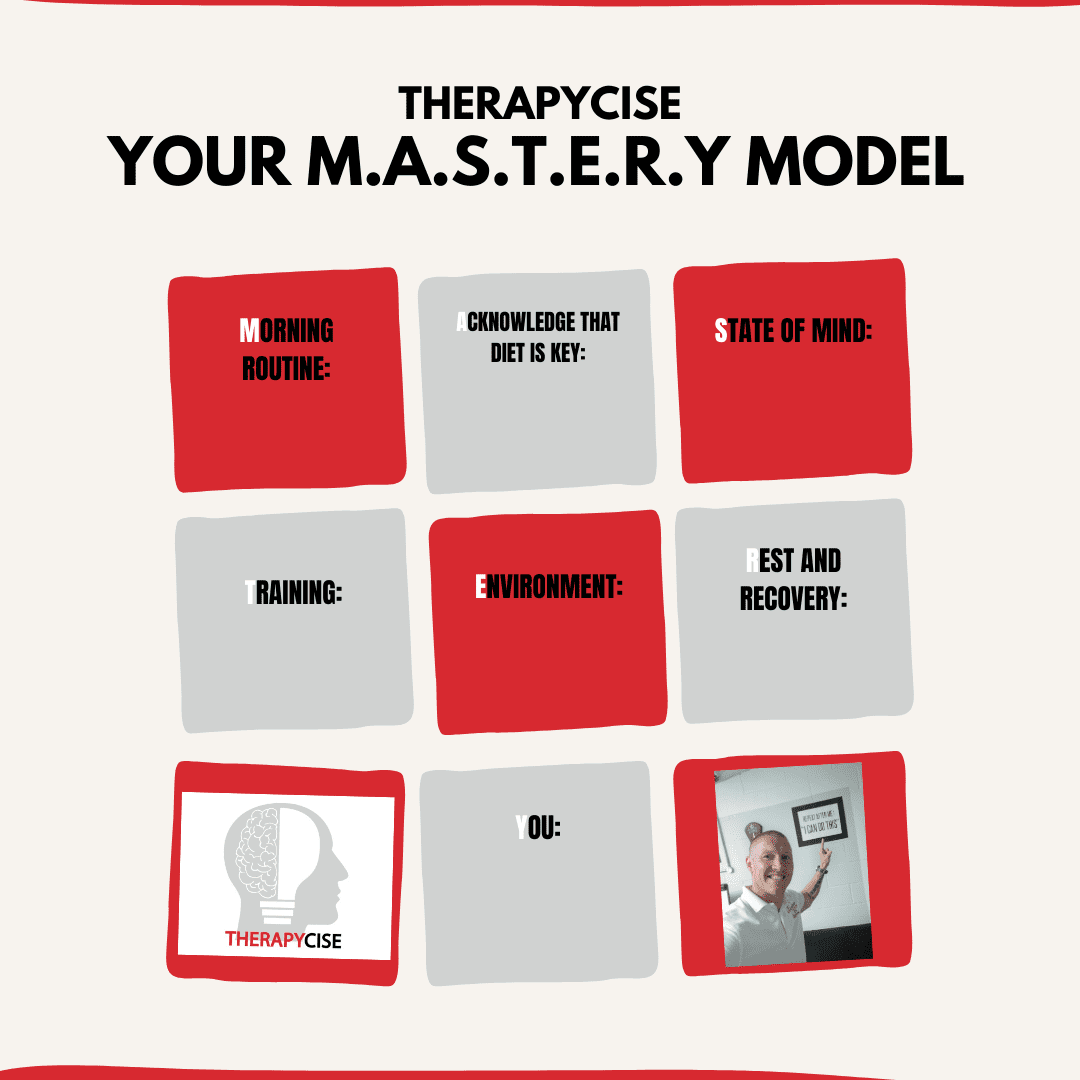
M.A.S.T.E.R.Y Model: The Complete Mental Game System for Athletes

At Therapycise — The Authority on the Mental Game, we know that performance isn’t just physical. The difference between good athletes and elite performers comes down to mental game training. That’s why we developed the M.A.S.T.E.R.Y Model, a proven system for sporting athletes, corporate athletes, and scholar athletes to dominate pressure, maintain focus, and build lasting confidence.

This isn’t motivation. It’s structure. It’s evidence-based mental performance engineering.


What is the M.A.S.T.E.R.Y Model?

The M.A.S.T.E.R.Y Model is a holistic mental performance framework designed to build all-round resilience while targeting your key performance objectives. Each pillar supports the others:

  • M – Morning Routines: Start every day with intention. Activate focus, energy, and mindset to win.
  • A – Acknowledge Diet: Proper nutrition fuels clarity, focus, and recovery — essential for consistent performance.
  • S – State of Mind: Develop composure, focus, and confidence that transfers directly to training, study, or work.
  • T – Training: Preparation is the foundation of performance. Build habits that reinforce your mental and physical capacity.
  • E – Environment: Shape surroundings, cues, and people to support growth and limit distraction.
  • R – Rest & Recovery: Recovery is performance. Proper sleep, reflection, and mental downtime build resilience.
  • Y – YOU: Ownership of choices, mindset, and daily actions is the multiplier for all other pillars.

This integrated approach ensures athletes don’t just improve in one area — they become all-round performers.


Why the M.A.S.T.E.R.Y Model Works

Most mental game strategies fail because they focus on a single skill or react to problems after they happen.

The M.A.S.T.E.R.Y Model is different:

  • It’s proactive — building systems to prevent breakdowns under pressure.
  • It’s holistic — addressing routines, diet, mindset, training, environment, recovery, and ownership.
  • It’s measurable — every pillar has actionable steps to track progress.

Athletes who use the M.A.S.T.E.R.Y Model:

  • Maintain composure under pressure
  • Build confidence that doesn’t waver
  • Stay consistent across training, study, or work
  • Recover faster and reduce mental fatigue
  • Align daily routines with long-term performance goals

Who Should Use the M.A.S.T.E.R.Y Model?

  • Sporting Athletes: Execute under pressure, sharpen focus, and maintain confidence for peak competition performance.
  • Corporate Athletes: Lead with clarity, stay calm under deadlines, and maintain productivity in high-stress work environments.
  • Scholar Athletes: Develop structured study routines, emotional resilience, and academic performance under pressure.

This model is the missing piece for any athlete or high-performer serious about mental game mastery.


Benefits of an All-Round Approach

The M.A.S.T.E.R.Y Model doesn’t isolate one mental skill. It develops a complete mental system. By strengthening all areas simultaneously while focusing sharply on your main objective, athletes see compounded results:

  • Improved confidence and clarity
  • Consistency in execution and routines
  • Enhanced resilience and stress control
  • Faster recovery and reflection cycles
  • Sustained high-level performance across environments

It’s why our clients trust us and why Therapycise gets so many referrals — athletes feel sharper, stronger, and more capable, and they share the results.


How to Get Started

The foundation for the M.A.S.T.E.R.Y Model begins with understanding the core principles that drive all elite mental performance. That’s why every athlete should start with our pillar post:

👉 The First Post You Should Read If You Want to Be the Best Athlete You Can Possibly Be MENTALLY

Read it. Apply it. Then step into the M.A.S.T.E.R.Y Model to build the mental game that guarantees consistent performance and growth.

When you combine an all-round mental game system with laser-focused objectives, performance stops being accidental — it becomes inevitable.

Mental game training and performance psychology visual | Therapycise, the authority on the mental game

Why Scheduling and Routine Management Decide Your Mental Game (Before Pressure Even Shows Up)

Talent is loud. Effort is visible.
But scheduling and routine management are the quiet assassins of inconsistency.

Every high performer we work with — sporting athletes, corporate athletes, and scholar athletes — eventually hits the same wall. Not because they lack motivation, but because their days are chaotic. When your schedule is reactive, your mental game follows suit.

A well-built routine does something powerful: it reduces decision fatigue. The brain loves predictability. When key behaviours are scheduled, the brain burns less energy deciding what to do and can invest more energy into doing it well.

Here’s the neuroscience without the fluff.

Your brain has limited cognitive bandwidth each day. Every decision drains it. Poor scheduling means you’re constantly choosing — when to train, when to study, when to rest, when to switch off. Over time, this overload hits the prefrontal cortex, the part of the brain responsible for focus, emotional regulation, and decision-making under pressure.

That’s when performance slips.

Strong routines act like mental scaffolding. They create stability for the nervous system. Consistent start times, training blocks, recovery windows, and reflection moments help regulate cortisol (stress hormone) and support dopamine release — the chemical that reinforces motivation and progress.

In plain terms:
A structured week makes confidence predictable.

Routine management isn’t about rigidity. It’s about control. When routines are aligned with performance goals, athletes stop relying on motivation and start relying on systems. That’s where consistency lives.

At Therapycise, we teach performers to design routines that:

  • Protect focus
  • Build confidence through repetition
  • Reduce emotional volatility
  • Create momentum across the week

Scheduling isn’t admin. It’s mental game training in disguise.

And here’s the kicker most people miss:
Your routine is your identity in action. If you want to think like a winner, your week must look like one.

If you’re serious about becoming a proper mental game operator, this pillar post lays the foundation for everything we coach — focus, habits, routines, confidence, and performance systems.

👉 Start here: The First Post You Should Read If You Want to Be the Best Athlete You Can Possibly Be MENTALLY
https://therapycise.co.uk/posts-must-read-for-athletes/

“Winners don’t rise to the occasion. They fall back on their routines. If you don’t like your results, audit your schedule.”

Mental game training and performance psychology visual | Therapycise, the authority on the mental game

Helping Your Child Develop a Winning Mental Game

Every parent wants their child to succeed. But success isn’t just about talent, technique, or grades.

It’s about mental strength.

Whether your child is:

  • a sporting athlete,
  • a scholar athlete,
  • or a young corporate athlete-in-the-making,

…their mental game shapes how they perform, respond to pressure, and develop confidence.

Without support, many kids struggle silently:

  • They get anxious before big competitions or exams
  • They struggle to maintain focus under pressure
  • Confidence wavers after mistakes
  • Habits that support success aren’t yet automatic

That’s where parents can make a huge difference — and where Therapycise comes in.

Why Working with Experts Matters

Parents want to help, but sometimes good intentions aren’t enough. Kids need systems, structure, and techniques that work under pressure.

With the right guidance, children learn to:

  • Manage nerves and pressure effectively
  • Train their focus and attention, not just their skills
  • Develop confidence that lasts, even when results fluctuate
  • Build winning habits early, before bad patterns form

We provide tools, routines, and frameworks that are practical, actionable, and age-appropriate, so your child develops a mental game that grows with them.

Early Intervention Creates Lasting Advantages

The earlier young athletes and scholars train their minds, the more natural these skills become. Think of it like conditioning their brains:

  • Focus becomes automatic
  • Confidence is stable
  • Decision-making improves under pressure
  • Emotional regulation becomes a habit

Waiting until problems appear is reactive.
Proactive mental game training is how consistent winners are created.

The Therapycise Approach

We work with parents and young performers to create:

  • Structured mental game training that complements practice or study
  • Frameworks for focus, clarity, and resilience
  • A foundation for long-term performance, not just short-term results

“A child with the right mental game foundation performs with confidence before the pressure even arrives.”

This isn’t about creating pressure. It’s about giving your child the tools to thrive under it.


Must-Read Foundation for Parents and Athletes

For parents and children serious about developing a winning mindset, this pillar post is the starting point. It lays the foundation for mental game training, focus, and performance systems:

👉 Read: Must-Read Mental Game Posts for Athletes
https://therapycise.co.uk/posts-must-read-for-athletes/


Final Thought

Supporting your child’s mental game isn’t optional — it’s the difference between hope and control.

Give them the frameworks, tools, and guidance that turn potential into consistent performance.

Mental game training and performance psychology visual | Therapycise, the authority on the mental game

The Weekly Advantage: Why Reflection Builds Better Weeks

Most performers finish a week and immediately rush into the next one.

No pause.
No processing.
No learning.

That’s not momentum — that’s mental noise.

High performers do something deceptively simple: they close the week properly. Reflection isn’t soft. It’s strategic. It’s how winning weeks are built on purpose instead of by accident.

The Prepare / Perform / Post-Week Feedback Cycle

Elite performance follows a rhythm:

Prepare → Perform → Review → Refine → Repeat

Miss the review and you break the loop.

Reflection is the bridge between effort and improvement. Without it, you repeat the same behaviours and hope for a different result. The brain doesn’t learn from experience alone — it learns from processed experience.

That’s neuroscience, not opinion.

Why Reflection Works (From the Brain’s Perspective)

When you reflect, you activate areas of the brain linked to:

  • Memory consolidation (locking lessons in)
  • Error correction (adjusting without emotional charge)
  • Pattern recognition (seeing what actually works)
  • Self-regulation (reducing impulsive reactions)

In simple terms: reflection turns activity into intelligence.

Skipping reflection keeps you busy.
Using reflection makes you better.

What Winning Weekly Reflection Actually Looks Like

This isn’t journaling for the sake of journaling. It’s targeted, efficient and performance-focused.

A strong post-week review asks:

  • What did I execute well under pressure?
  • Where did my mental game wobble?
  • What patterns showed up — good or bad?
  • What one adjustment gives me the biggest return next week?

No drama. No self-criticism. Just data.

The goal isn’t perfection. It’s progression.

Reflection Builds Confidence, Not Doubt

Here’s the paradox: people avoid reflection because they fear it will highlight flaws.

In reality, reflection stabilises confidence.

Why? Because confidence grows when you trust your process. Reviewing your week shows evidence of growth, effort and control — even when outcomes weren’t perfect.

Confidence built on awareness lasts longer than confidence built on results.

Preparing a Winning Week Starts at the End of This One

When reflection is done properly, preparation becomes easier.

You stop guessing what to fix.
You stop overloading your week.
You stop chasing everything.

Instead, you enter the next week with:

  • Clear priorities
  • Sharper focus
  • Reduced mental clutter
  • Intentional energy use

That’s how weeks start strong — not with hype, but with clarity.

This Cycle Works Everywhere

Sporting athletes refine execution and pressure control.
Corporate athletes sharpen decision-making and energy management.
Scholar athletes improve focus, learning efficiency and exam performance.

Different arenas. Same cycle. Same nervous system.

The Therapycise Standard

At Therapycise, reflection isn’t optional — it’s built in.

We prepare with intention.
We perform with awareness.
We review without ego.

That cycle creates consistency, composure and long-term confidence. It’s how performers stop drifting and start directing their weeks.


Must-Read Mental Game Foundation

If you want to deepen your understanding of how elite performers think, review and refine their mental game, this pillar post lays the groundwork:

👉 Read: Must-Read Mental Game Posts for Athletes
https://therapycise.co.uk/posts-must-read-for-athletes/

This is where understanding turns into application.


Final Thought

Winning weeks aren’t accidental.
They’re reviewed into existence.

Close the week properly, and the next one starts ahead of the game.